 By Rob Howell
In the beginning, there was IBM Planning Analytics on Cloud.
Well, not exactly. TM1, the original name for Planning Analytics, can trace its lineage back to the early 1980s. However, IBM launched Planning Analytics on Cloud (PAoC) in 2016, giving organisations a fully managed alternative to running Planning Analytics on their own infrastructure.
At Aramar, we’ve been the leader in helping customers move from on-premise environments to the cloud since 2018. While removing the burden of managing servers and infrastructure is a major benefit, the biggest advantage for many customers is staying up to date. IBM continues to enhance Planning Analytics at a rapid pace, releasing updates to the web interface roughly every four weeks. Customers running older on-premise installations can quickly fall behind, while cloud customers gain access to new functionality as soon as it becomes available.
Today, organisations have two cloud deployment options available:
-
IBM Planning Analytics on Cloud (PAoC)
-
IBM Planning Analytics as a Service (PAaaS)
While both remove the need to manage infrastructure, there are some important differences worth understanding before planning a migration.
Although IBM has always described PAoC as a SaaS offering, it differs from what many people think of as a traditional multi-tenant SaaS application. The web interface is shared, but each customer has their own dedicated Planning Analytics environment and database. This means your data remains completely separate from other customers while IBM manages the infrastructure, maintenance and upgrades on your behalf.
Fast forward a few years and, in late 2023, IBM released Planning Analytics as a Service (PAaaS). This provided a different flavour of Planning Analytics for customers to use, running on hyperscaler infrastructure through IBM’s partnerships with AWS and later Microsoft Azure, rather than IBM Cloud.
For customers joining the Planning Analytics club for the first time, or who are now migrating away from a local installation (what took you so long?), PAaaS tends to be the first choice. It features the latest Planning Analytics Engine, which allows for improved resilience, and the technical configuration is much more flexible compared to PAoC.
This flexibility translates to pricing too, meaning you don’t end up paying for system resources you don’t need.
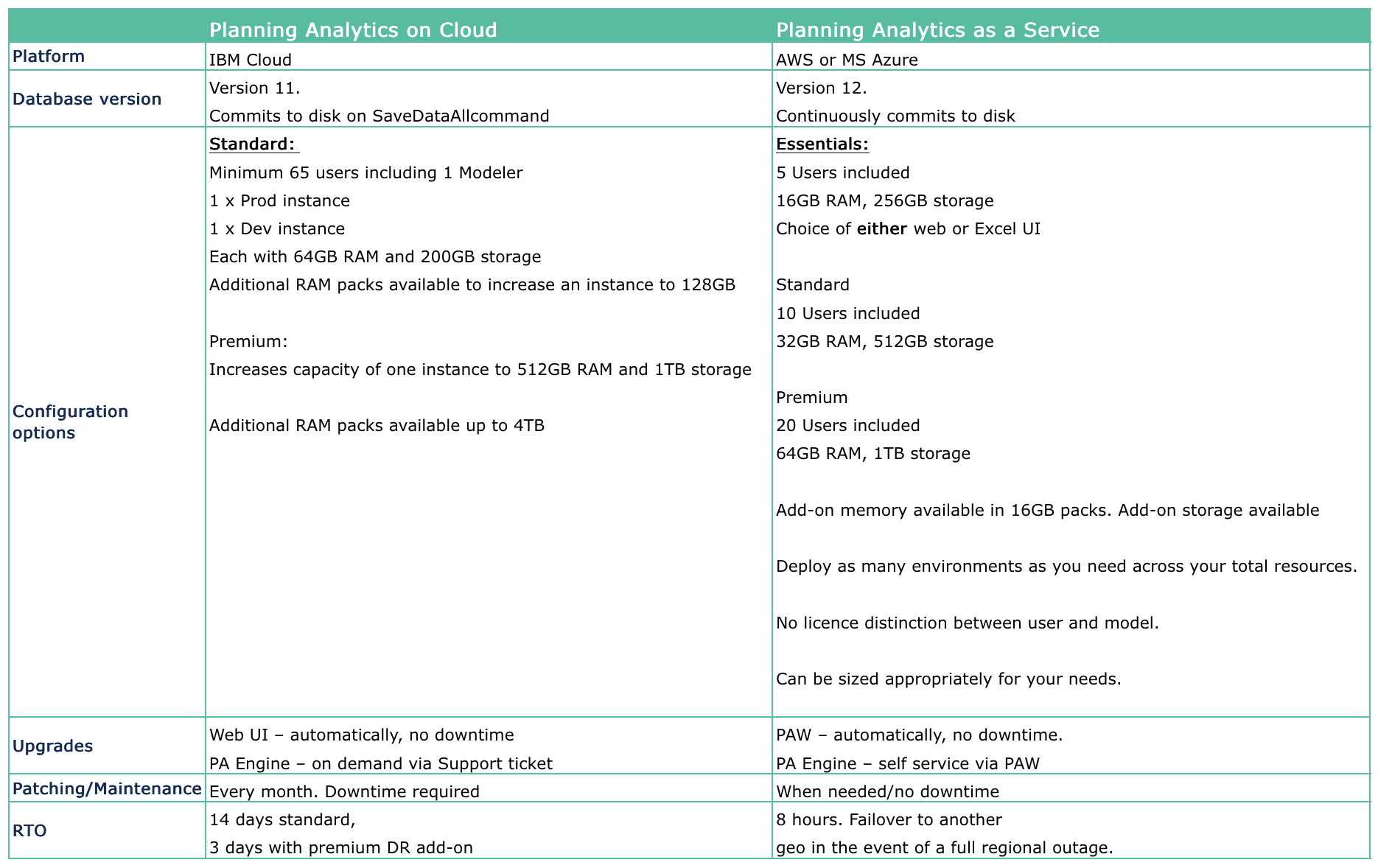
Here’s the comparison at a glance:
Which Option Is Right for You?
Both Planning Analytics on Cloud and Planning Analytics as a Service remove the burden of managing infrastructure while ensuring you stay current with IBM’s latest developments.
For most new cloud deployments and migration projects, Planning Analytics as a Service will be the preferred choice due to its flexibility, resilience and modern architecture.
However, many organisations continue to successfully run Planning Analytics on Cloud and benefit from IBM’s fully managed service.
If you’re considering a move from an on-premise environment, the right option depends on your current architecture, user requirements, growth plans and budget.
At Aramar, we’ve been helping organisations modernise their Planning Analytics environments since the earliest days of IBM’s cloud offerings. If you’d like to discuss your options, we’re always happy to help.
Read More Planning Analytics Updates & Insights