 By Rob Howell
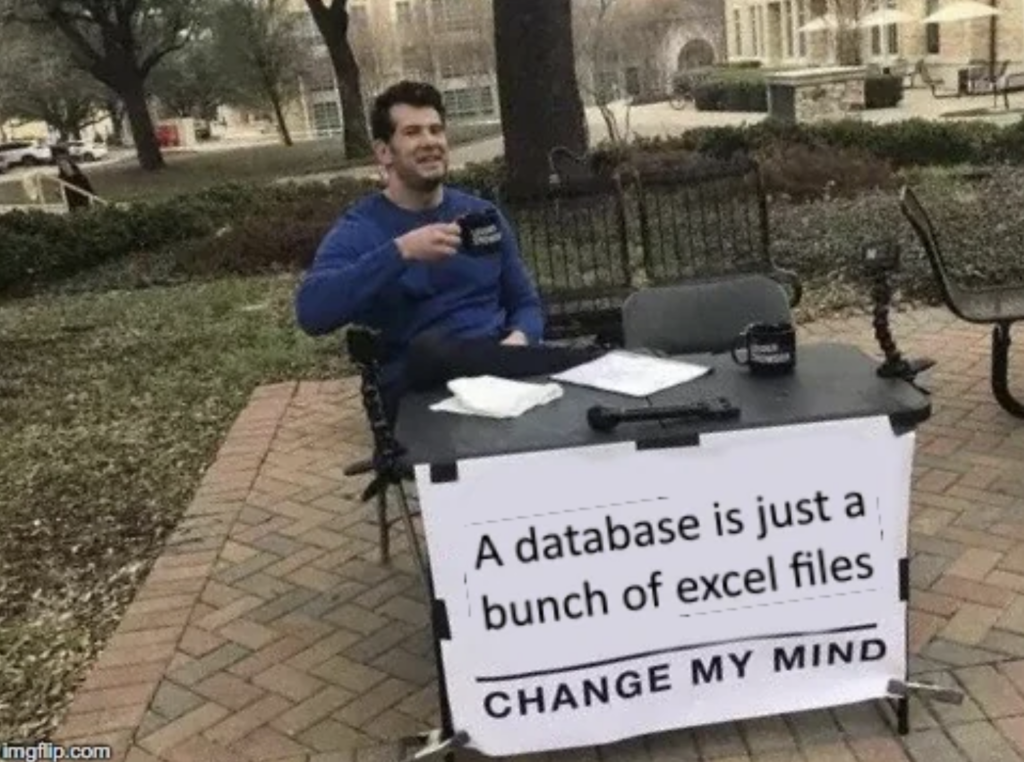
When somebody posted this under one of our LinkedIn posts, we all had a good laugh 🤣
Because, on the surface, it feels true.
Both databases and spreadsheets contain rows, columns and data. If you’re looking at a budget, customer list or sales report, they are pretty similar.
But saying a database is just a collection of spreadsheets is a bit like saying a supermarket inventory system is just a shopping list.
Technically, both are lists of items.
The difference is scale.
At home, a shopping list works perfectly well. You jot down that you’ve run out of milk or bread, and add them to your list. It doesn’t need to be more complicated because only a handful of people use it.
The supermarket has a very different challenge. Thousands of products are moving in and out every day. Multiple staff members need access to the same information, to maintain stock levels and orders. Customers expect products to be available everyday.
A simple shopping list would not survive a day. The same principle applies to spreadsheets.
For a small team, spreadsheets are often the perfect solution. They’re flexible, familiar and quick to set up.
But, as organisations grow, so does the complexity. Dozens or even hundreds of people need to plan, submit and report from the same data. Before long, there are multiple versions of the same file, different calculations being used in different places, and endless conversations about which spreadsheet is the correct one.
That’s where databases come in.
A database doesn’t simply store information. It provides structure, consistency and control. Multiple users can enter data, update records and run reports simultaneously while working from the same source of trusted data.
And that’s why platforms such as IBM Planning Analytics exist.
Finance teams still get the flexibility they love from spreadsheets, but underneath sits a powerful database that allows hundreds of users to collaborate, plan and report using the same source of truth.
So, has your mind been changed?
Is a database just a bunch of Excel files?
Or is it the difference between a shopping list on your fridge and the system that keeps a supermarket running?
If your organisation is starting to outgrow spreadsheets, we’d be happy to help you explore the alternatives.
Learn more about IBM Planning Analytics